
AI-Trained Workforce In Outsourcing: Transforming Business Operations
|
Getting your Trinity Audio player ready...
|
The world of outsourcing is changing—and fast. The old model of moving tasks offshore primarily to save costs is no longer enough. Today, organizations expect their outsourcing partners to do more: to be smarter, faster, and more innovative.
At ProcessVenue, we see this transformation firsthand. Powered by AI, outsourcing is evolving from a back-office function into a strategic driver of efficiency, insight, and innovation. It’s no longer just about completing tasks—it’s about unlocking real business value.
The AI-Trained Workforce: At the heart of Strategic Outsourcing
Historically, the primary drivers for outsourcing were often straightforward: access to a larger talent pool, reduction in operational expenditures, and the ability to offload non-strategic functions. While these factors still remain relevant, the advent of AI has dramatically expanded outsourcing’s value proposition. It has moved beyond simple task delegation to become a conduit for specialized, AI-augmented expertise that drives tangible business outcomes.
At the heart of this transformation lies the AI-trained workforce – human professionals meticulously upskilled to effectively deploy, manage, and interpret AI technologies. This is not about replacing humans with AI, but about augmenting human capabilities with AI tools, creating a highly efficient and intelligent operational model.
These professionals possess a unique blend of competencies:
- Proficiency in AI Tools & Platforms: They are adept at navigating and utilizing various AI and automation platforms, including machine learning applications, natural language processing (NLP) tools, robotic process automation (RPA), and advanced analytics software.
- Advanced Data Literacy & Interpretation: Beyond basic data handling, these individuals can critically analyze AI-generated outputs, identify patterns, extract actionable insights, and translate complex data into strategic recommendations.
- Human Oversight and Validation: Crucially, they provide the indispensable human judgment necessary for overseeing AI operations, validating results, troubleshooting anomalies, and ensuring ethical and compliant deployment of technology. This human-in-the-loop approach is vital for maintaining accuracy and accountability.
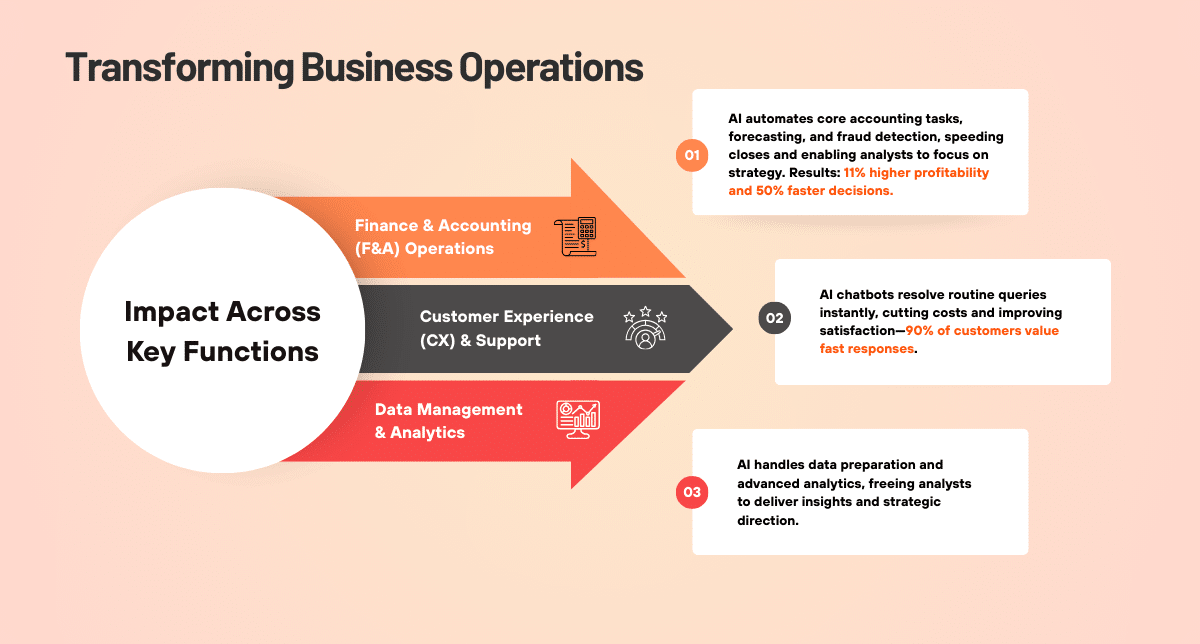
How an AI-trained workforce transforms finance, customer experience, and data analytics operations
The impact of an AI-trained workforce in outsourcing is tangible, measurable and pervasive across business functions. Let me share a few instances:
- Finance & Accounting (F&A) Operations: F&A tasks such as invoice processing, expense categorization, and bank reconciliations are now handled with remarkable speed and accuracy by AI. It also assists in predictive cash flow management and robust fraud detection. This shift not only accelerates financial closures but also enables AI-trained human analysts to dedicate more time to strategic financial planning, risk assessment, and compliance. The impact is clear: companies using AI in decision-making report up to 11% higher profitability and 50% faster decision-making.
- Customer Experience (CX) & Support: AI-powered chatbots and virtual assistants proficiently handle routine inquiries, providing instant responses and freeing AI-trained human agents to address more complex, nuanced customer issues. This tiered approach ensures efficient service delivery and enhances customer satisfaction. Studies show that AI-powered customer service automation can reduce costs by automating repetitive tasks and improve customer experience, with 90% of customers valuing quick responses.
- Data Management & Analytics: An AI-trained workforce excels in handling automated data cleansing, extraction, and transformation. It leverages various AI tools to perform advanced analytics and generate sophisticated reports. This allows senior human analysts to focus on interpreting trends, identifying strategic opportunities, and crafting compelling narratives from the data leading to more informed decision-making across the organization.
ProcessVenue: Architecting the AI-Ready Enterprise
At ProcessVenue, the philosophy is rooted in making client back-office operations AI-ready, not AI-dependent. We understand that true transformation comes from intelligently integrating AI tools with highly skilled human talent, creating a symbiotic relationship that optimizes processes and unlocks strategic value. We empower our workforce with the latest AI competencies, enabling us to leverage automation for repetitive tasks while dedicating our expertise to complex problem-solving and insightful analysis.
A testament to this approach is our work with a rapidly scaling e-commerce client who faced challenges in managing high volumes of product data entry and inventory reconciliation. By deploying our AI-trained back-office team, which utilized intelligent automation for data extraction and validation, we enabled them to process product information 30% faster and achieve a 99% accuracy rate in inventory management. This provided them with real-time visibility into their stock, preventing overselling and improving customer satisfaction.
Strategic Imperatives for the C-Suite: Embracing the Augmented Future
For C-suite executives, having an outsourcing partner with an AI-trained workforce is a strategic imperative that goes beyond tactical adjustments. It demands a re-evaluation of how talent and technology converge to drive business objectives. Leaders must shift their perspective on outsourcing from a purely cost-driven decision to a strategic investment in intelligent capacity.
Here are key considerations for an AI transformation:
- Strategic Provider Selection: Partnering with outsourcing providers who not only possess robust AI capabilities but also demonstrate a commitment to continuous workforce upskilling and strong governance frameworks is crucial.
- Data Security and Compliance: Robust frameworks for data security and regulatory compliance are paramount when integrating AI into outsourced operations. This includes ensuring adherence to critical industry standards such as HIPAA, GDPR and SOC 2 Type II.
- Integrating Internal & External Talent: Developing strategies for seamlessly blending the capabilities of an augmented outsourced workforce with in-house teams fosters a cohesive and high-performing enterprise.
As PwC’s 2025 predictions suggest, companies that make AI intrinsic to their operational fabric will establish lasting advantages, recognizing that successful AI governance is defined not just by risk mitigation but by the achievement of strategic objectives and strong ROI.
FAQs
What defines an “AI-trained workforce” in outsourcing?
An AI-trained workforce in outsourcing refers to human professionals who are skilled in leveraging AI tools and technologies to perform their tasks more efficiently and intelligently. They are adept at using AI for automation, data analysis, and decision support, while critically overseeing AI outputs and applying human judgment for complex scenarios.
How does an AI-trained workforce impact operational efficiency?
This model significantly boosts operational efficiency by automating repetitive tasks, accelerating data processing, and improving accuracy. For example, in back-office operations like product data entry, it can lead to faster processing times and higher accuracy rates, freeing human professionals for more strategic work.
Is this approachaboutreplacing human workers with AI?
No, it is explicitly about augmentation, not replacement. The goal is to make operations AI-ready, not AI-dependent. AI handles routine, data-intensive tasks, while humans provide critical oversight, strategic thinking, problem-solving, and client relationship management, elevating the overall value proposition of the workforce.
What key skills are essential for an AI-trained workforce?
Key skills include proficiency in various AI tools, strong data literacy and analytical capabilities, critical thinking for AI output validation, and adaptability for continuous learning as AI technologies evolve. Communication skills are also vital for translating AI-driven insights into actionable business strategies.
How should C-suite executives approachoutsourcingproviders for an AI-trained workforce?
C-suite executives should prioritize providers who demonstrate robust AI capabilities, a commitment to continuous workforce upskilling, and strong governance frameworks for data security and compliance. The focus should be on strategic partnerships that deliver intelligent capacity and drive long-term value, rather than just cost reduction.