
 admin_processvenue25
  July 7, 2025
Content of blog
- Manual work is the real issue: Expensive, Slow, and Easy to ignore.
- Why automation makes sense (especially now in 2025): No more operational “hazard”
- What sets ProcessVenue apart:
- Manual vs. automated: a quick side-by-side
- Real-Time impact we’ve seen
- Is this only for big teams?
- What’s Next?
- Curious what this could look like for your organization?
In 2025, companies are still losing money to slow, manual, and error-prone workflows. While small and medium-sized businesses focus on growing revenue and empowering sales teams, the backend often becomes the most neglected part of the organization.
We’ve seen it firsthand: Smart teams, doing smart work, are still spending hours managing data, updates, or double-checking forms. It’s not because the people are underperforming. It’s because the systems are stuck in 2015.
Tasks like invoice handling, data entry, and internal reporting are still being done manually in many companies. When data leaks happen, most companies claim it to be “one-time errors.”
And, as privacy becomes a big issue quickly, companies continue to stay in denial, as the alternate fix—AI Automations, is perceived to be questionable in terms of implementation.
Manual work is the real issue: Expensive, Slow, and Easy to ignore.
- Teams are doing far more copy-paste work than problem-solving.
- Every single “small inefficiency” keeps adding up—across tools, teams, and time zones, further creating a ticking time bomb of errors that can impact entire workflows.
Individually, none of the steps are complex or difficult. But together? They create bottlenecks that compound as the team grows. Ten employees doing redundant work is a cost. A hundred doing it is a crisis.
Companies don’t need more expensive hires or big systems, but they need a fix that isn’t complex or scattered.
Manual operations are failing—through delays, miscommunication, and missed signals. And yet, it’s not people who fault it, it’s the process. The issue is obvious: the system depends too much on manual repetition and not enough on structured, scalable flow.
Why automation makes sense (especially now in 2025): No more operational “hazard”
We’re in a time where companies need to do more with less.
Automation isn’t about replacing people. It’s about letting them focus on bigger visions, allowing leaders to focus on maximizing revenue, and expanding their client base by eliminating the micro challenges–majorly backend.
When done right, here’s what automation can do:
- Reduce Time Consumption: Tasks that used to take hours now take minutes, or less.
- Increase Accuracy Rate: Human errors drop by over 50% in most cases.
- Predictive Scalability: You can grow without growing your team proportionally.
- Effective Transparency: Everything becomes traceable in real time. Meaning, no more time-consuming checks for status.
Whether it’s claims processing, data validation, form handling, or customer record updates, the rule is simple: If it’s repetitive and rule-based—it can be automated.
What sets ProcessVenue apart:
Our team at ProcessVenue doesn’t just “add automation.” We sit down with your actual workflows and rebuild them from the ground up—with a super efficient tech stack designed to run silently in the background.
What we use:
AI decision logic for exceptions that used to require human review.
AI Chatbots for instant, intelligent responses that scale support without scaling headcount.
OCR (Optical Character Recognition) for converting scanned documents into searchable data (eliminated the need of manual entry).
HAI (Human-Augmented Intelligence) for managing large scale data while experts validate and optimize complex scenarios.
CRM connectors and APIs to unify siloed systems.
Real-time dashboards so leadership isn’t running blind.
After assisting more than 100+ clients with automation setup, we can safely say—Most clients don’t need a new fancy tool, they just need strategic clarity. Our job is to help teams map what’s slowing them down and design a lean, scalable system around it.
Manual vs. automated: a quick side-by-side
| Task | Manual Process | With ProcessVenue |
| Invoice generation | Agent pulls info from multiple sheets | RPA bot extracts, validates, generates & sends invoice |
| Lead assignment | Spreadsheet + email chain | CRM auto-routing based on custom logic |
| Employee onboarding | Multiple systems, multiple forms | Unified form triggers all back-end processes |
| Monthly reporting | Hours of Excel wrangling | Automated dashboards update in real time |
Real-Time impact we’ve seen
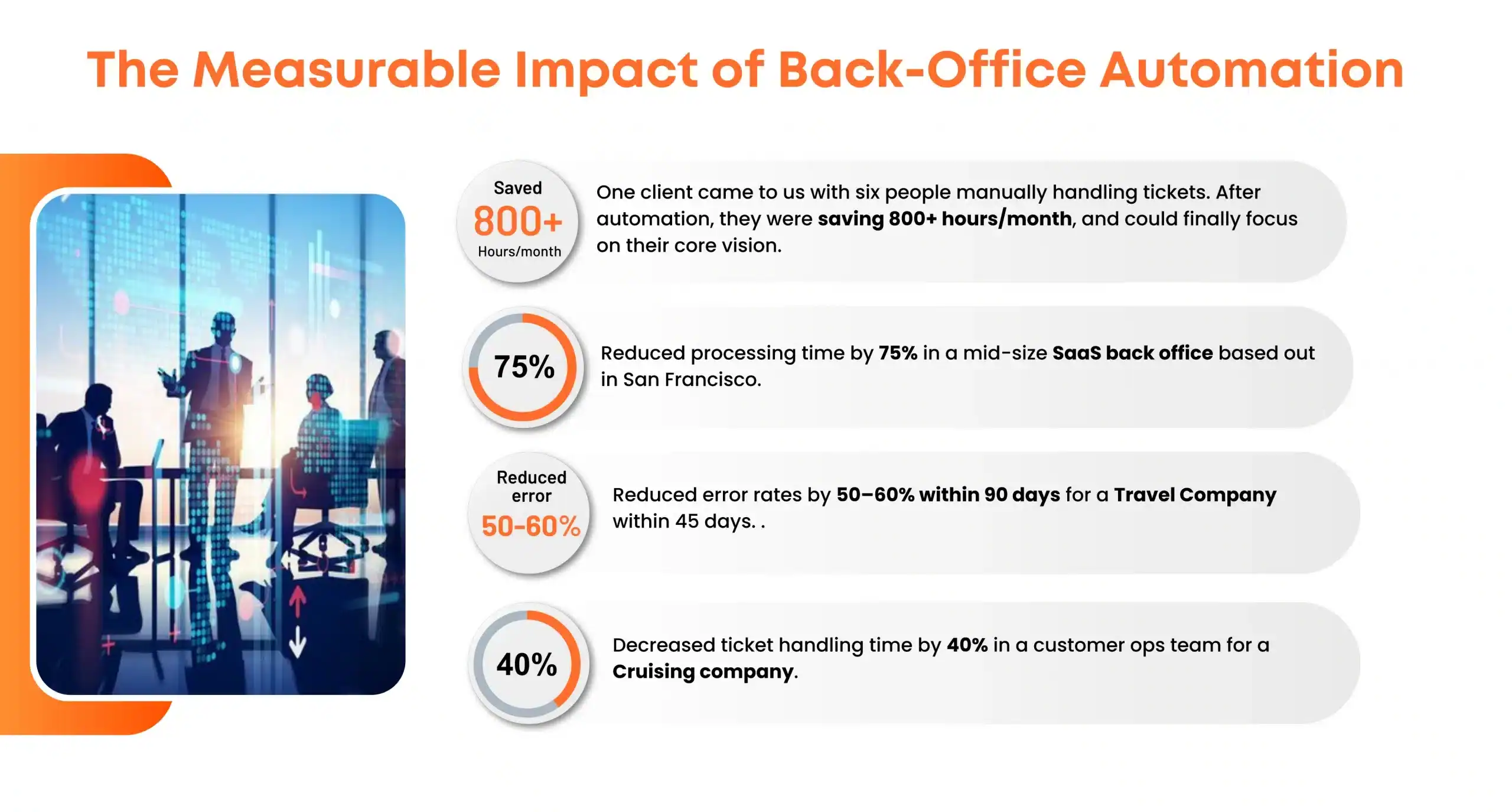
One client came to us with six people manually handling tickets. After automation, they were saving 800+ hours/month, and could finally focus on their core vision.
More results:
- Reduced processing time by 75% in a mid-size SaaS back office based out in San Francisco.
- Reduced error rates by 50–60% within 90 days for a Travel Company within 45 days. .
- Saved 800+ hours/month for an insurance client.
- Decreased ticket handling time by 40% in a customer ops team for a Cruising company.
But here’s what matters more:
- Teams regained legitimate control back.
- No more short term fancy AI-Tools solutions.
- Just clean, trackable, scalable operations.
Is this only for big teams?
Nope. In fact, the smallest teams benefit most. Startups and scale-ups can’t afford bloated operations. A few smart automations today can save you from hiring five unnecessary roles tomorrow. The earlier companies fix their back office, the faster the company grows without chaos.
What’s Next?
If you’re still managing business-critical operations through spreadsheets, Slack pings, and manual emails, you’re not just wasting time. You’re building risk. And it’s avoidable, at least for NOW.
At ProcessVenue, we’ve built and rebuilt workflows for SaaS, Travel & Cruising Companies, and service-based businesses of all sizes. We don’t sell tools on collective subscriptions. We create strategic systems (based on every client’s need) that run effectively in the background, so your team can actually focus on growth.
Curious what this could look like for your organization?
We’re currently offering a free diagnostic of your back-office workflow map, no pitch, just insight.
Just email a quick brief to sales@processvenue.com with “workflow” in the subject line. We’ll reply with a quick diagnostic, no forms, no fluff.