
 sahil wadhwa
  August 18, 2026
Content of blog
Every month, organizations process thousands of utility bills like electricity, water, gas, telecom, internet, often across multiple locations, vendors, and formats. Despite advances in finance automation, utility bills remain one of the most manual, error-prone, and fragmented processes inside finance and operations teams.
A global study by McKinsey estimates that nearly 60% of finance activities can be automated using existing technologies, yet document-heavy workflows like invoice and utility bill processing remain among the least optimized. This gap represents more than just inefficiency; it represents lost visibility, delayed decisions, and avoidable costs.
Utility bills in the form of PDFs, scanned images, emails, paper invoices, typically have varying layouts, inconsistent line items are a nightmare for machines to read. That’s exactly where AI-powered data extraction and Intelligent Document Processing (IDP) are changing the game.
Why Utility Bill Processing Is a Hidden Bottleneck
Utility bills are rarely treated as a strategic process. They’re often seen as “routine accounting work,” until something goes wrong. In practice, they introduce several operational challenges:
- Non-standard formats: Each utility provider uses a different layout, terminology, and billing logic.
- Manual data entry dependence: Finance teams spend hours copying numbers from PDFs into ERP systems.
- High error probability: Missed line items, incorrect meter readings, duplicate bills, and tax mismatches are common.
- Approval delays: Bills arrive late, get stuck in inboxes, or wait for manual validation.
- Limited consumption visibility: Fragmented data makes it difficult to analyze usage patterns across locations.
The key challenge is that as volumes increase, these problems scale linearly while finance teams don’t. They consume large amounts of valuable business time.
As Peter Drucker famously said: “If you can’t measure it, you can’t improve it.” When utility data lives in unstructured documents, meaningful measurement becomes almost impossible.
What Is Automated Utility Bill Data Extraction?
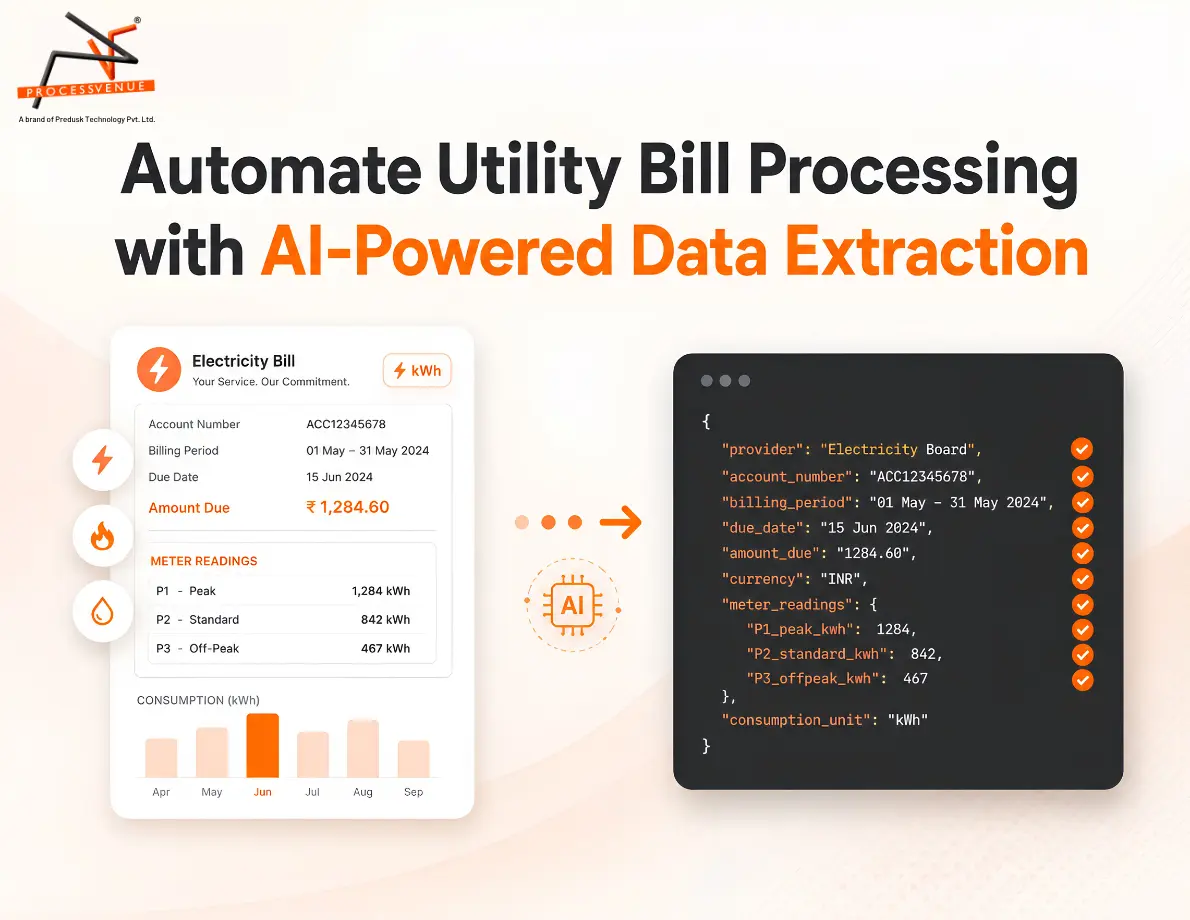
Automated utility bill data extraction uses AI models to read, interpret, and structure information from utility bills without relying on fixed templates. So, instead of humans manually entering data, AI systems automatically extract key fields such as:
- Vendor and service provider details
- Customer or account number
- Billing period and due date
- Meter readings and consumption units
- Fixed charges, variable charges, taxes, and surcharges
- Total payable amount
Once structured, this data can seamlessly flow into accounting systems, ERPs, dashboards, or audit workflows without the need for rekeying. The result: faster processing, fewer errors, and data that’s ready for analysis.
How AI-Powered Data Extraction Actually Works
At the heart of utility bill automation is a combination of Document AI, machine learning, and Intelligent Document Processing (IDP).
A typical workflow looks like this:
- Document ingestion: Utility bills enter the system via email, uploads, shared folders, or APIs. Formats may include PDFs, scanned images, or mobile photos.
- AI-driven document classification: The system identifies the document as a utility bill and recognizes its subtype- electricity, water, gas, telecom, etc.
- Context-aware data extraction: Instead of relying on fixed coordinates, AI models understand the context by recognizing fields even when labels, layouts, or positions change.
- Validation and exception handling: Business rules flag anomalies such as:
-
- Unusual spikes in consumption
- Duplicate bills
- Missing mandatory fields
- Charges outside expected ranges
These exceptions are routed for human review.
- System integration: Validated, structured data is pushed directly into ERP, accounting, or reporting systems. Over time, the system improves as it learns from corrections and new document variations.
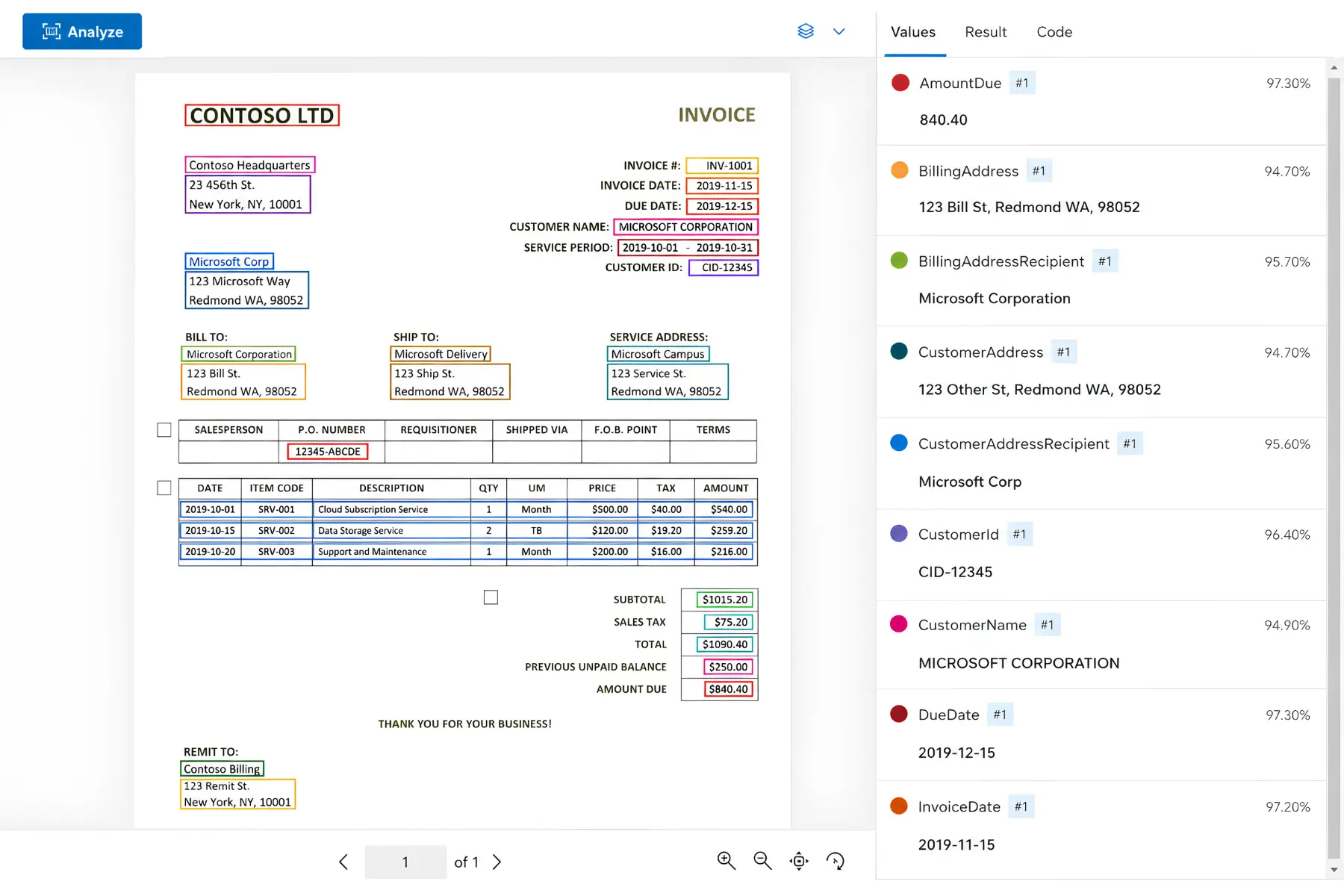
A representation of AI-Powered Data Extraction
Utility Bill Automation vs Traditional OCR
Many organizations experimented with Optical Character Recognition (OCR) years ago and abandoned it out of frustration. The reason wasn’t ambition; it was limitations.
| Traditional OCR | AI-Powered IDP |
| Template-based extraction | Learns from layout variations |
| Breaks with format changes | Adapts to new vendors |
| Reads text only | Understands document context |
| High manual correction effort | Human-in-the-loop refinement |
| Limited scalability | Enterprise-grade automation |
As Andrew Ng succinctly puts it: “AI is the new electricity. Just as electricity transformed nearly everything 100 years ago, AI will transform every industry.”
Utility bill processing is one of those quiet but inevitable transformations happening in the industry.
Business Impact of Utility Bill Automation
Organizations that deploy AI-powered data extraction for utility bills typically experience measurable benefits:
- 60–80% reduction in manual processing effort
- Shorter approval and payment cycles
- Lower accounting and reconciliation errors
- Improved audit readiness with structured data trails
- Greater cost visibility across locations, vendors, and services
Beyond efficiency, structured utility data unlocks insights:
- Energy consumption trends
- Vendor benchmarking
- Anomaly and leakage detection
- Sustainability and ESG reporting
What was once “back-office noise” becomes decision-grade intelligence ready to serve your business with accuracy and efficiency no manual operation can ever match.
Why Utility Bills Are a Perfect IDP Use Case
Utility bills check every box for Intelligent Document Processing:
- Semi-structured documents
- High volume and repetition
- Multiple layouts and vendors
- Clear downstream system dependencies
IDP bridges the gap between unstructured documents and structured enterprise systems without forcing organizations to redesign existing workflows. It allows finance teams to automate without losing control.
When Does Utility Bill Automation Make Sense?
Automation delivers the highest ROI when:
- Bills come from multiple vendors or geographies
- Monthly volumes cross a few hundred documents
- Manual effort is delaying finance close cycles
- Errors, disputes, or missed payments are common
- Cost optimization and energy tracking matter strategically
In short, once utility bills become a process, not just paperwork, automation is overdue.
ProcessVenue’s View: Automation with Accountability
At ProcessVenue, we see utility bill automation as more than a technology upgrade or a cost arbitrage based outsourcing activity, it’s an operational design exercise.
AI-powered data extraction works best when paired with:
- Clear field definitions and validation logic
- Human-in-the-loop reviews for edge cases
- Secure, compliant data handling practices
- Seamless ERP and finance-system integration
The objective isn’t speed alone. It’s trustworthy, audit-ready data that finance teams can rely on- month after month.
Final Thought
Utility bills may never be glamorous, but they sit at the intersection of cost control, compliance, and operational discipline.
With Document AI and Intelligent Document Processing, organizations can finally move this workflow out of inboxes and spreadsheets and into a scalable, AI-ready operating model.
The real win isn’t just automation. It’s visibility, accuracy, and control- at enterprise scale.