
 sahil wadhwa
  August 4, 2026
Content of blog
A few weeks ago, I was speaking with the marketing head of a fast-growing D2C brand. Their team had done all the “right” things like strong keyword rankings, consistent content output, clean technical SEO. Yet the question they asked me was telling:
“We’re getting traffic, but why does it feel like fewer people are actually finding us?”
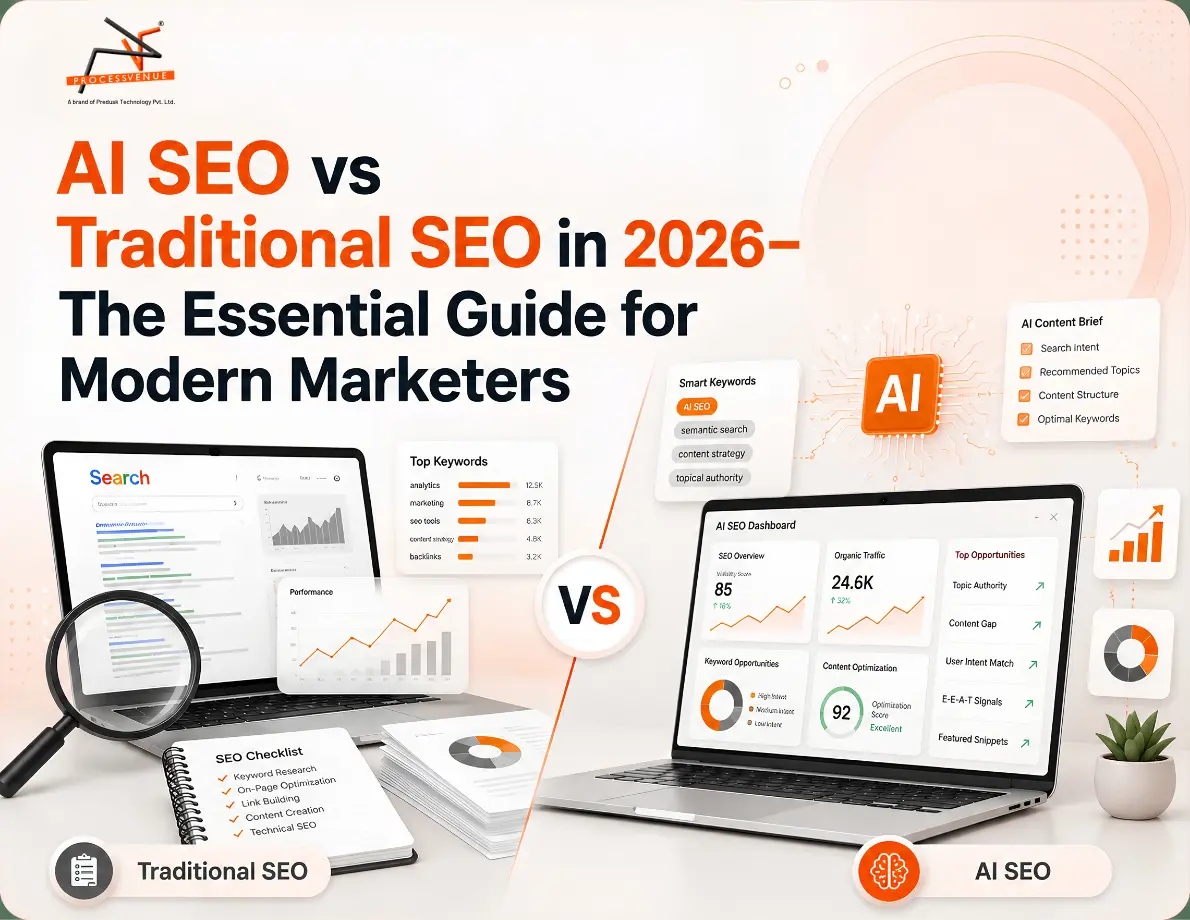
That conversation sums up where SEO stands in 2026. Search hasn’t stopped working. It has simply evolved faster than most teams have adapted. And that’s where the debate around AI SEO vs Traditional SEO really begins.
Search has fundamentally changed
Today, users don’t just search for keywords. They ask questions, compare options, and expect synthesized answers. AI Overviews, voice search, and multimodal queries are now mainstream. Google and other platforms are trying to understand context, intent, and usefulness, not just keyword density.
Thus, search engines today behave less like directories and more like decision engines. This shift changes the role of Search Engine Optimization (SEO) entirely.
The job of marketers is no longer about telling search engines what your content is about. It’s about helping AI systems understand why your content is the best answer.
Why Traditional SEO now struggles
Let’s be clear: Traditional SEO built the foundation of digital visibility. Keywords, backlinks, on-page optimization, and technical hygiene helped brands scale discovery for years. For a long time, ranking on page one was almost synonymous with success. But the cracks started showing as search behaviour changed.
Traditional SEO is largely rule-based. You research keywords, create content around them, optimize pages, and wait for results. In a world where users typed short, predictable queries, this worked well.
In 2026, it struggles because:
- Search queries are longer, conversational, and intent-heavy.
- Ranking does not guarantee visibility due to AI summaries and zero-click results.
- Content cycles are slow and manual.
- Optimization happens after publishing, not before.
Traditional SEO still matters, but on its own, it no longer keeps up with how modern search engines think. This is where AI SEO enters the picture.
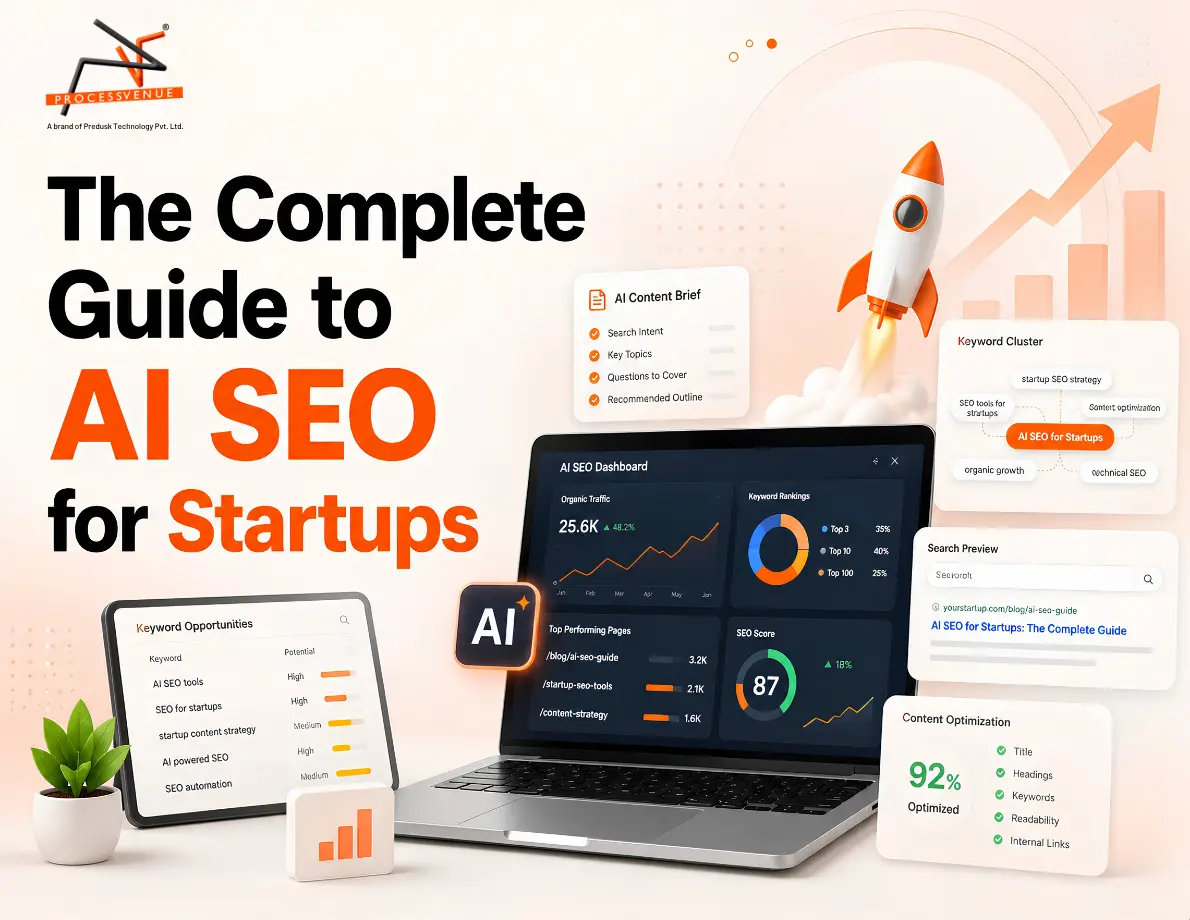
What exactly is AI SEO?
AI SEO is not about replacing SEO professionals with tools. It’s about using artificial intelligence to make SEO adaptive, predictive, and intent-driven.
At its core, AI SEO uses machine learning and large data models to:
- Analyze user intent at scale.
- Predict what content is likely to rank before it’s published.
- Continuously optimize content based on real-time performance.
- Understand semantic relationships, not just keywords.
AI SEO optimization focuses on meaning, not mechanics. Instead of chasing rankings, it helps brands align content with how search engines and users think.
There’s a big difference between occasionally using AI tools and building an AI-first SEO strategy. The latter treats SEO as a learning system, not a checklist.
AI SEO vs Traditional SEO: A practical comparison
Here’s how the difference shows up in real life:
| Traditional SEO | AI SEO |
|---|---|
| Relies on static keyword research. | Identifies patterns in user intent and evolving search behaviour. |
| Optimizes content after publishing. | Optimizes content before and after publishing, continuously. |
| Measures success by rankings and traffic. | Focuses on relevance, engagement, and conversion quality. |
| Depends heavily on manual effort. | Uses automation to scale insights, not content spam. |
Simply put, Traditional SEO is rule-based. AI SEO is learning-based.
Where AI SEO delivers real business impact
The biggest advantage of AI SEO isn’t speed. It’s alignment.
AI-driven systems help marketers understand:
- What users actually want at different stages of the journey.
- Which topics are saturated and which gaps exist.
- How content needs to change as intent evolves.
This results in:
- Higher quality traffic, not just more traffic.
- Better performance for long-tail and niche searches.
- Faster content refresh cycles.
- Stronger conversion relevance.
This is also why many teams now explore AI SEO services instead of relying only on in-house manual optimization. The complexity of modern SEO demands both technology and execution discipline.
A mid-sized B2B SaaS company came to us with steady rankings but stagnant pipeline contribution from SEO. Instead of reworking keywords in isolation, our team applied an AI SEO optimization approach — clustering search intent across the buyer journey, analysing content gaps using AI models, and then layering human editorial judgment on top.
Within four months, the client saw a clear shift: fewer but more relevant pages driving traffic, stronger engagement from high-intent visitors, and a measurable increase in demo requests originating from organic search. The real win wasn’t rankings alone, but SEO finally behaving like a revenue-aligned channel rather than a traffic engine.
Why SEO cannot be fully automated: The Human + AI model
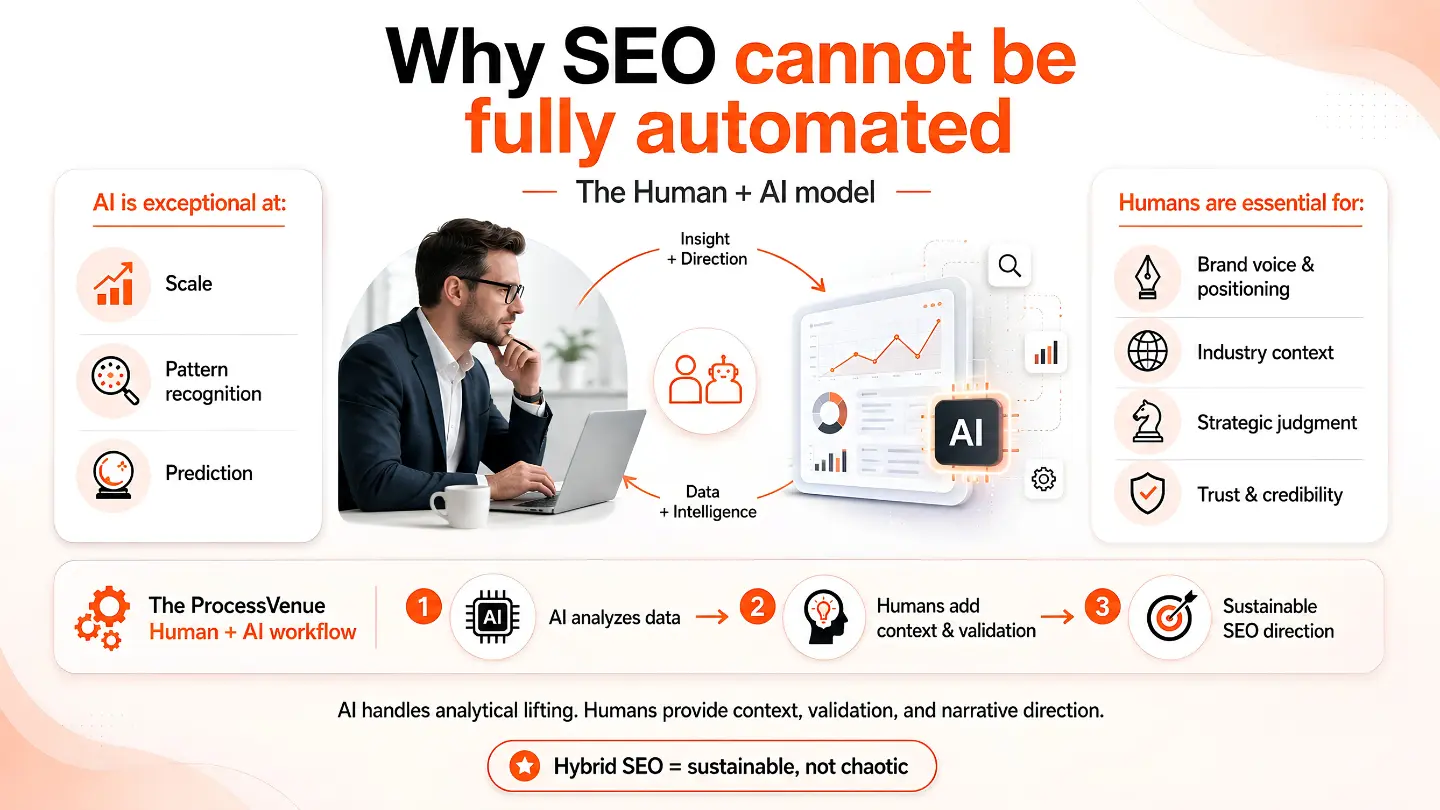
Despite all the progress, SEO cannot be handed over entirely to machines. AI is exceptional at scale, pattern recognition, and prediction. Humans are essential for:
- Brand voice and positioning
- Industry context
- Strategic judgment
- Trust and credibility
At ProcessVenue, we strongly believe in a Human + AI model. AI does the heavy analytical lifting. Humans provide context, validation, and narrative direction. This hybrid workflow is what makes AI SEO optimization sustainable rather than chaotic.
How marketers should approach AI SEO in 2026
AI SEO adoption doesn’t need to be overwhelming. A practical approach looks like this:
- Start with AI-assisted research and content optimization
- Use AI to identify intent clusters and content gaps
- Build feedback loops between SEO, content, and analytics
- Focus on workflows, not just tools
The biggest mistake I see teams make is chasing shiny platforms instead of designing repeatable processes.
ProcessVenue’s point of view on AI SEO services
From our experience, SEO in 2026 is not a tool problem. It’s a data, content, and execution problem.
Effective AI SEO services combine:
- Clean, well-structured data
- AI-driven insight generation
- Human-led quality control
- Continuous optimization cycles
When done right, AI SEO becomes a growth system, not a marketing expense. The debate isn’t really AI SEO vs Traditional SEO. The real shift is from static optimization to adaptive intelligence.
We believe that marketers who treat SEO as a one-time setup will keep chasing rankings. Those who treat it as a learning system will stay visible, relevant, and trusted.