
 sahil wadhwa
  September 15, 2026
AI is one of the most disruptive trends of today, and no wonder this makes a lot of businesses anxious. A common concern from across the sectors that keeps surfacing is “We want to use AI, but we are not sure if we are prepared for it.”
This challenge points to a fundamental truth about AI adoption that AI rarely fails because of weak models. It fails because of weak data. Thus, the quality of data in a business affects its AI readiness, and this leads us directly to the door of data annotation.
As AI adoption accelerates in 2026 across use cases like WhatsApp chatbots, automated bookkeeping, product catalog classification, and document extraction, businesses face a critical decision:
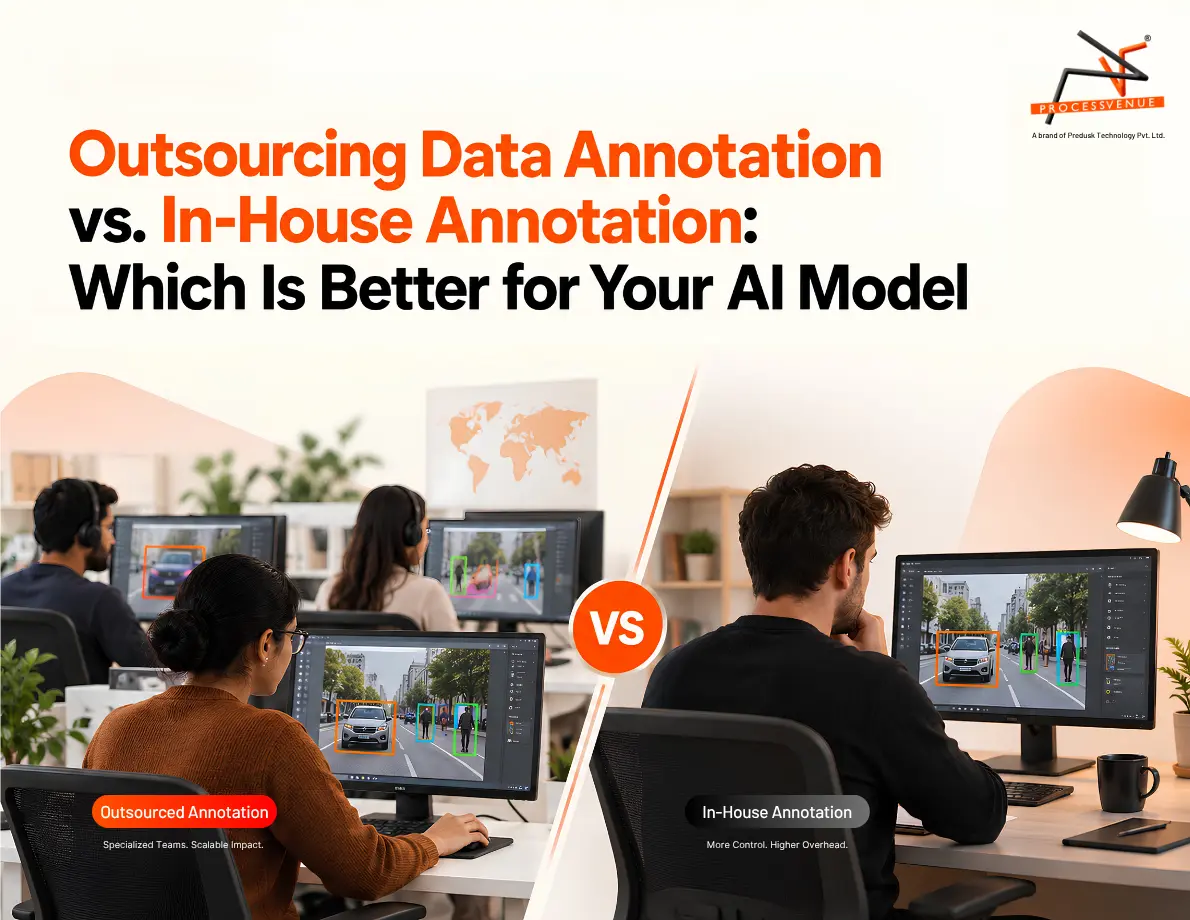
Should data annotation be managed in-house, or outsourced to a specialist data annotation partner?
This decision goes beyond cost considerations. It directly affects speed, accuracy, data quality, and ultimately, the business impact AI can deliver.
Let’s look at each of the two scenarios.
Option 1: In-House Annotation
Some businesses prefer this because it feels safer and more familiar. It also seems easier to control in the early stages, especially when AI use cases are still evolving. However, as data volumes grow, in-house annotation often competes with core business priorities and slows down overall execution.
✔ Benefits
- You understand your business context best: If your domain is niche like medical devices or legal services, your team already knows subtle nuances.
- Better data privacy control: Everything stays inside your system and hence no one else has access to it.
- Easy to start small: If you just need 200–300 labels, your team can handle it on their own.
✖ Limitations
- Extremely time-consuming: Annotation is repetitive work. You need bandwidth and consistency. Most businesses are pressed for both. Resources are required for other important tasks as well.
- Quality is inconsistent: There have been cases where two employees labeled the same message differently. Inconsistent labels confuse AI. For example: “Late delivery” vs “Refund request”, or “Neutral tone” vs “Angry tone”.
- Hard to scale: What starts with 300 labels quickly becomes 30,000. One Bengaluru edtech thought that their in-house interns could annotate everything. But accuracy collapsed as soon as they hit volumes. That’s a common story.
Option 2: Outsourcing to a Data Annotation Company
This is where outsourcing starts to shine, especially for fast-growing businesses operating across multiple markets and data types. Specialist teams bring established workflows, quality controls, and experience across languages, formats, and industries that are difficult to replicate in-house. This allows organizations to scale data annotation quickly, maintain consistency, and improve AI performance without pulling internal teams away from core business priorities.
✔ Benefits
- Accuracy and consistency: Professional annotators follow guidelines which prevent guesswork. These include things like Double-layer QA, Taxonomy rules, and Review loops.
- Scalability: You can go from 1,000 labels to 1 million without stress since the annotation partner has the capability to ramp up headcount deployment.
- Multi-language capability: Typically, fast-growing businesses need to operate in multiple languages across regions. Specialized teams handle this far better because they have been trained accordingly.
- Faster results: A logistics startup outsourced classification of 25,000 support emails. Their model accuracy jumped from 58% → 92% in four weeks. ROI becomes easier to justify.
- Lower overall cost: Costs related to hiring, training, supervision, or rework overhead are borne by outsourcing partners. This becomes a variable expense for you, and not a capital investment.
✖ Limitations
- You need a trusted partner: Not all annotation vendors understand business context. Choosing poorly means quality issues and costs overrun.
- Initial onboarding time: The vendor must learn your business rules and hence you need to spend time onboarding and setting the SOPs.
Cost Comparison: In-House vs Outsourced
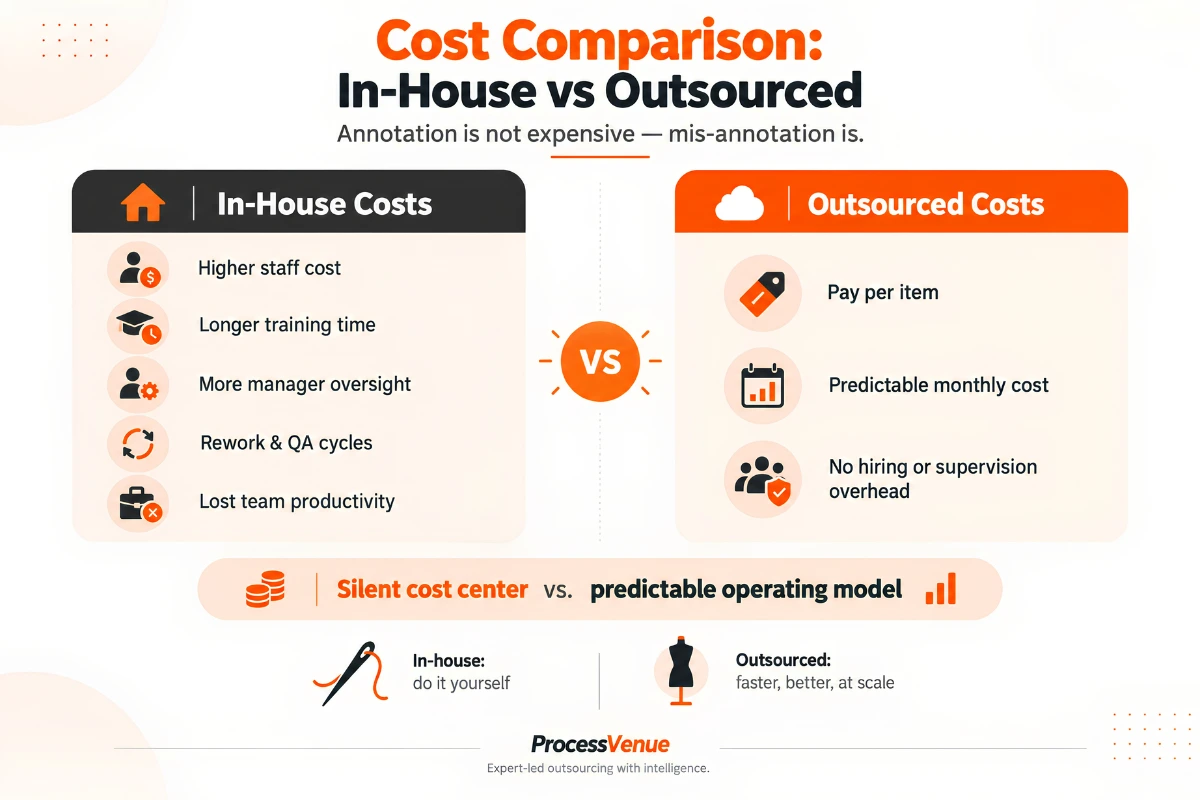
Whenever you are stuck with the decision about in-house Vs outsourcing this mantra will offer you clarity: Annotation is not expensive- mis-annotation is. Most businesses underestimate the hidden costs of running annotation internally until delays, rework, and team burnout start showing up in the numbers.
In-House Costs: What often looks like a simple “we’ll do it ourselves” often turns into:
- Increased Salaries or reallocated staff time
- Longer training time for teams to learn annotation rules
- More manager oversight to maintain consistency
- Elongated QA cycles and corrections when labels don’t match
- Lost productivity from people who should be focusing on sales, support, finance
These hidden layers turn annotation into a silent cost center – one that businesses rarely account for.
Outsourcing Costs: With outsourcing, the model flips as you move from ‘doing it’ to ‘managing it’. This means you:
- Pay per annotated item only
- Gain predictable monthly cost that you can manage
- No hiring, training, or supervision overheads for you
Here’s a great analogy to ponder: Doing annotation in-house is like stitching your own clothes. You can do it – but a tailor will do it faster, better, and at scale.
Which One Gives Better AI Accuracy?
You can save on costs, you can stretch timelines but if your AI accuracy is weak, the entire project fails. Accuracy is the real deal-breaker. AI models learn patterns from labeled data. If the labels are inconsistent, shallow, or biased, the model will behave the same way, it’s like teaching someone using the wrong textbook.
AI accuracy depends heavily on:
- Consistent labels across thousands of samples
- Clear, expert-driven annotation rules
- Bias-free tagging for sensitive categories
- Strong QA checks at every stage
This level of consistency is difficult to achieve internally unless you build a mini annotation department with reviewers, annotators, SOPs, and continuous training. For most businesses that’s like adding another cost center.
What professional annotation teams bring:
- Multi-pass reviews for error correction
- Human-in-the-loop quality gates
- Domain-trained specialists
- Automated workflow systems to avoid drift
Most businesses discover this only after their internal AI pilot underperforms, and by then, they’ve already spent more time and money than expected.
Security and Confidentiality – The BIG concern
The most common question on the minds of executives is: “Is my data safe if I outsource annotation?”. The short answer is ‘Yes’ – if you choose the right partner who has in place required capabilities and experience. Here are some of the key compliances that your potential data annotation partner should have:
- ISO/IEC 27001 certified security standards
- NDA-backed projects
- Access-control management
- Encrypted environments
- Data masking when required
ProcessVenue adheres to all the above since we understand the sensitivity of data to any business. Sensitive fields can be redacted before annotation. Your customer identities remain protected, and you can have peace of mind to focus on more strategic projects.
ProcessVenue’s View: A Balanced, Practical Approach
For most growing businesses, the right answer is rarely fully in-house or fully outsourced. The most effective approach combines specialist-led data annotation with strong domain context from internal teams. This ensures speed and consistency at scale, while keeping AI models aligned with real business realities.
Most growing businesses eventually move to a hybrid model: Basic rules built in-house → large-scale annotation outsourced. Our Human + AI annotation teams have labeled millions of data points for businesses across industry sectors – everything from WhatsApp chats to e-commerce catalogs.
Here’s a simple Data Annotation In-house vs Outsourced Checklist
Ask yourself these questions. Your answers will guide you to the correct choice.
- Do I have enough internal bandwidth?
- How much data needs annotation?
- How soon do I need results?
- Is consistency important?
- Do I need multi-language support?
Your answers will guide you naturally toward in-house or outsourced annotation.
Closing Thought
At the end of the day, the question is not “Should I annotate in-house or outsource?”. The real question is “How do I ensure my AI learns correctly?”
Because when your data is strong, your AI becomes a competitive advantage – not a gamble. If you want to explore a hybrid or fully outsourced annotation model, ProcessVenue can help you get started quickly and safely.