
 sahil wadhwa
  August 25, 2026
Content of blog
When startup founders share their thoughts about SEO in business seminars, the conversation usually starts with frustration. Blogs are written, keywords are researched, agencies are hired; yet results feel slow, inconsistent, or unclear. Many quietly wonder whether SEO still works at all.
The truth is simple: SEO still works but the way startups approach SEO hasn’t kept pace with how search itself has evolved.
Search engines today are driven by artificial intelligence. They understand intent, context, and usefulness far better than they did even a few years ago. For startups, this creates a new opportunity. Not to “game” SEO faster, but to learn, adapt, and compete smarter using AI.
That’s where AI SEO for startups comes in.
What Is AI SEO
AI SEO is the use of artificial intelligence to support and automate key parts of the SEO process like research, content optimization, technical monitoring, and performance analysis; while humans continue to own strategy, judgment, and brand voice.
It aims to optimize content so that it’s discoverable within AI-driven search experiences such as Google’s AI Overviews, ChatGPT, and Perplexity, with a strong focus on user intent, topic authority, and structured data rather than just keywords.
It’s also equally important to clarify what AI SEO is not.
– It is not about auto-generating hundreds of blogs and hoping something ranks.
– It is not about replacing SEO thinking with tools.
Instead, SEO with artificial intelligence helps startups answer better questions:
- What are people searching for?
- Why do some pages perform better than others?
- Which content deserves more effort and which doesn’t?
AI changes the speed and clarity of these answers.
The Core Pillars of AI SEO
When done right, AI SEO rests on a few clear pillars.
- Research at scale – AI can analyze thousands of keywords, competitors and search results to uncover patterns humans would miss.
- Content optimization – AI evaluates structure, relevance, and topical coverage, helping content become more useful rather than more verbose.
- Technical SEO monitoring – AI tracks site health continuously instead of relying on periodic audits.
- Automation with oversight – Repetitive checks are automated, but decisions remain human-led.
This balance is what makes SEO automation sustainable rather than risky.
How AI SEO differs from Traditional SEO
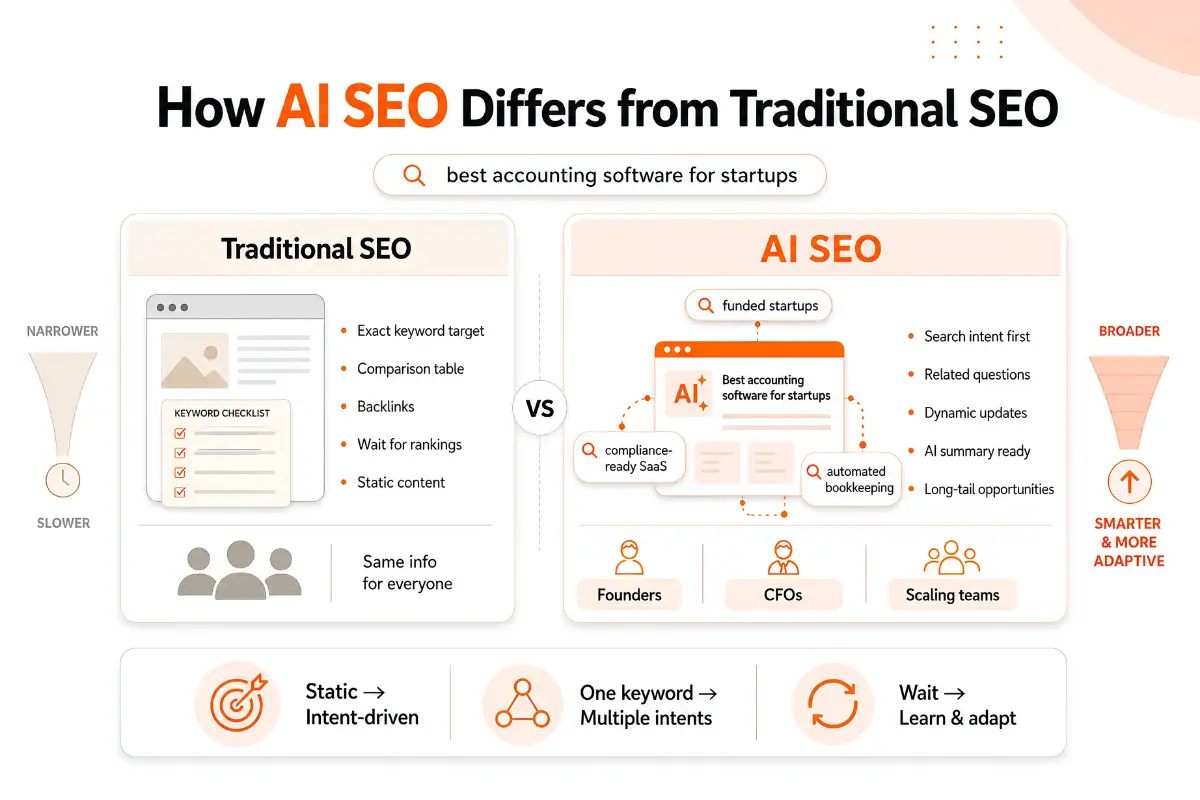
A startup offering cloud accounting software wants to rank for the query: “best accounting software for startups.” With Traditional SEO, the team optimizes a blog around this exact keyword, adds comparison tables, builds backlinks, and waits for rankings to improve. The content is largely static and assumes all searchers want the same information, regardless of whether they are first-time founders, CFOs, or scaling teams.
With AI SEO, the focus is on the search intent of the same query. AI models identify related questions like “accounting software for funded startups,” “compliance-ready tools for SaaS,” and “automated bookkeeping for early-stage teams.” AI-powered SEO tools structure the content to address these varying intents, update dynamically based on engagement signals, and optimize for AI summaries. This helps startups move beyond obvious keywords and discover long-tail, high-intent opportunities.
AI Content Optimization: From Guesswork to Precision
One of the biggest advantages of AI SEO is in AI content optimization. AI can analyze top-performing pages and identify:
- Structural gaps
- Missing subtopics
- Weak introductions
- Poor internal linking
- Over-optimization issues
Used well, AI becomes a sharp editor. It tells you what to improve, not what to write. The mistake startups make is letting AI write content end-to-end without review. Search engines are getting better at detecting thin, generic material. The winning model is human insight + AI refinement. AI improves clarity. Humans provide originality.
AI SEO for Technical and On-Page Optimization
Technical SEO often feels intimidating to founders – page speed, indexing, broken links, schema, mobile usability. AI simplifies this by continuously monitoring technical health and prioritizing issues based on impact. Instead of long audit reports, startups get clear signals on what actually matters.
This reduces dependency on specialists and ensures problems are caught early. For lean teams, this form of SEO automation saves time without sacrificing quality.
Where Startups Go Wrong with AI SEO
AI SEO fails when it is treated as a shortcut. Common mistakes include:
- Publishing AI-generated content without editing
- Over-optimizing for keywords instead of usefulness
- Relying on tools without a clear startup SEO strategy
- Ignoring brand voice and differentiation
A fintech startup revealed they had “done everything right” with AI SEO – dozens of articles, perfect keyword density, and automated publishing. Traffic went up briefly, but engagement collapsed. Once they slowed down, they rewrote their core pages with real customer insight, and used AI only for optimization, leading to stable performance.
AI amplifies intent. If the intent is weak, AI only accelerates failure.
Building a Practical AI SEO Workflow
The startups that succeed with AI SEO don’t use more tools; they use them more deliberately. A practical AI SEO workflow starts with clarity.
One SaaS startup shared its experience about making a simple shift: instead of publishing new blogs every week, they reviewed performance weekly and used AI to improve their top ten pages. Headlines were sharpened, sections were expanded and internal links were restructured. Within three months, organic leads doubled; without increasing content volume.
The discipline of reviewing performance frequently, improving what already exists, and letting AI guide attention (not decisions) is what separates mature AI SEO from content factories. When used this way, SEO with AI becomes a continuous learning loop & not a production treadmill.
The Future of SEO for Startups
Search is undergoing a quiet but profound shift. AI didn’t create this change, but it is accelerating it. What separates signal from noise is discipline. When AI is applied with context and intent, it sharpens decision-making; when used blindly, it only amplifies clutter. The real differentiator is not the toolset, but how well AI is embedded into workflows that reflect business priorities, customer intent, and measurable outcomes.
At ProcessVenue, our work in AI SEO reflects this philosophy. We approach it as an operating capability that combines data-led intent analysis, AI-assisted optimization, and human validation, so SEO becomes a learning system that improves relevance, efficiency, and alignment with business goals over time.
The future of SEO will belong to those who treat it not as a channel, but as a capability. And for startups, that capability powered by AI and guided by human judgment can be the difference between chasing visibility and earning it.