
 sahil wadhwa
  September 1, 2026
Content of blog
Picture a large enterprise at the end of a financial quarter. Thousands of invoices are waiting to be validated, customer onboarding documents are queued for compliance checks, contracts sit in shared folders awaiting review, and leadership is asking for real-time visibility into cash flow and risk exposure.
The data needed to answer these questions already exists, however, it is scattered across PDFs, scanned forms, emails, and semi-structured documents. Teams are forced to rely on manual checks, spreadsheets, and fragmented document automation to keep up. According to McKinsey, nearly 80% of enterprise data remains unstructured, much of it embedded in documents.
Result: Not just slower operations, but delayed decisions, higher error rates, and growing compliance risk.
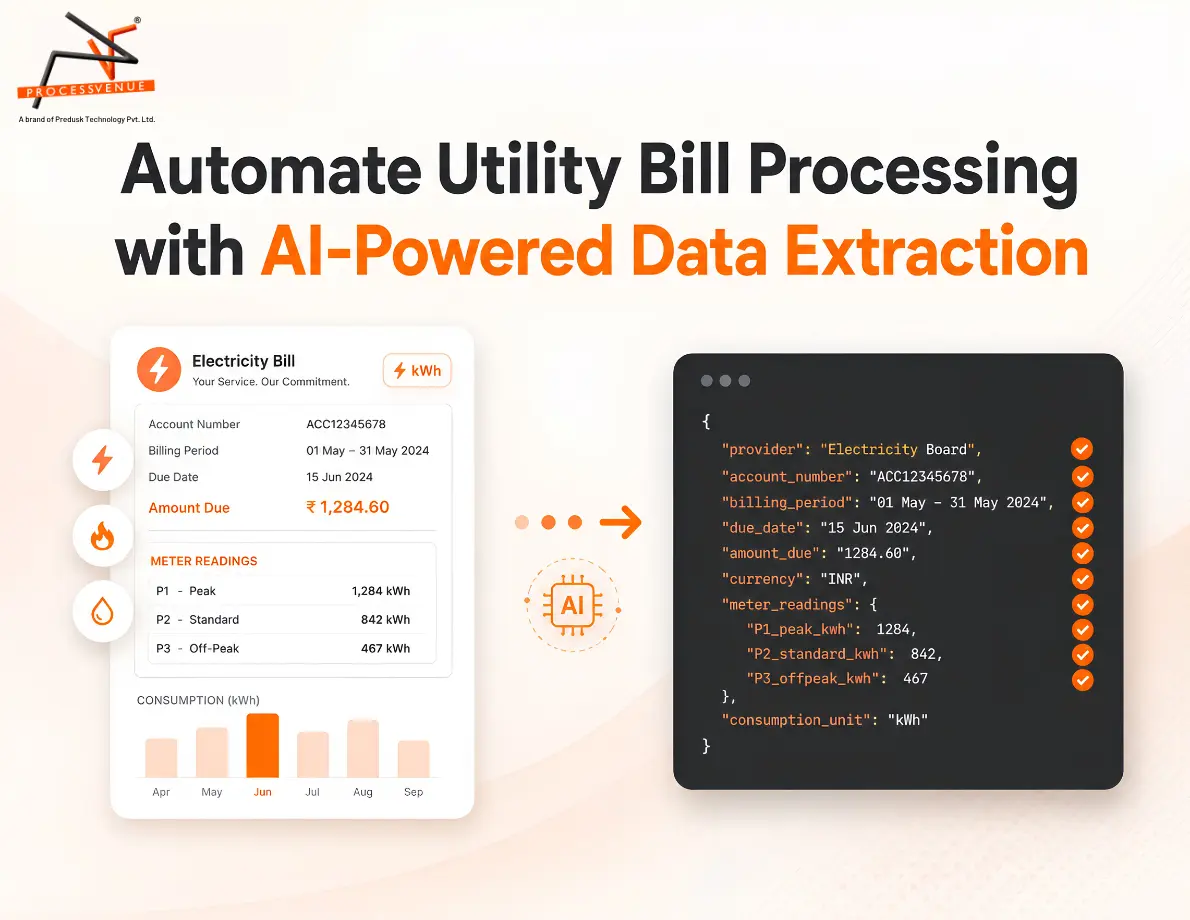
This is where AI-powered document processing enters the picture. It does more than simply extracting text. It understands it. The real differentiator lies in how these systems are trained, governed, and continuously improved, often through a carefully designed human+AI annotation process.
Why Document Processing Has Reached an Inflection Point
Document processing has evolved steadily over the last two decades. Early efforts focused on digitization and basic optical character recognition (OCR), followed by rule-based automation that worked only for highly standardized documents. As machine learning entered workflows around 2018, systems became more flexible, however, accuracy remained inconsistent due to poor training data quality.
By 2021, enterprises began scaling AI across finance, compliance, and operations, exposing a new bottleneck: trust in data. Speed was no longer the issue- AI model accuracy was.
Today, organizations are adopting human-in-the-loop data annotation models to combine scale with judgment. Document processing has moved from a cost-saving task to a strategic data capability thus marking its true inflection point.
Impact of Data Quality
AI models learn patterns from data. In document processing, this means learning how fields appear across thousands or millions of examples. If the training data is incomplete, inconsistent, or incorrectly labeled, even the most advanced model will produce unreliable outputs.
This is why training data quality matters as much as model architecture. Gartner has consistently noted that poor data quality costs organizations millions annually through rework, operational errors, and missed insights. In document-heavy workflows, these costs multiply quickly.
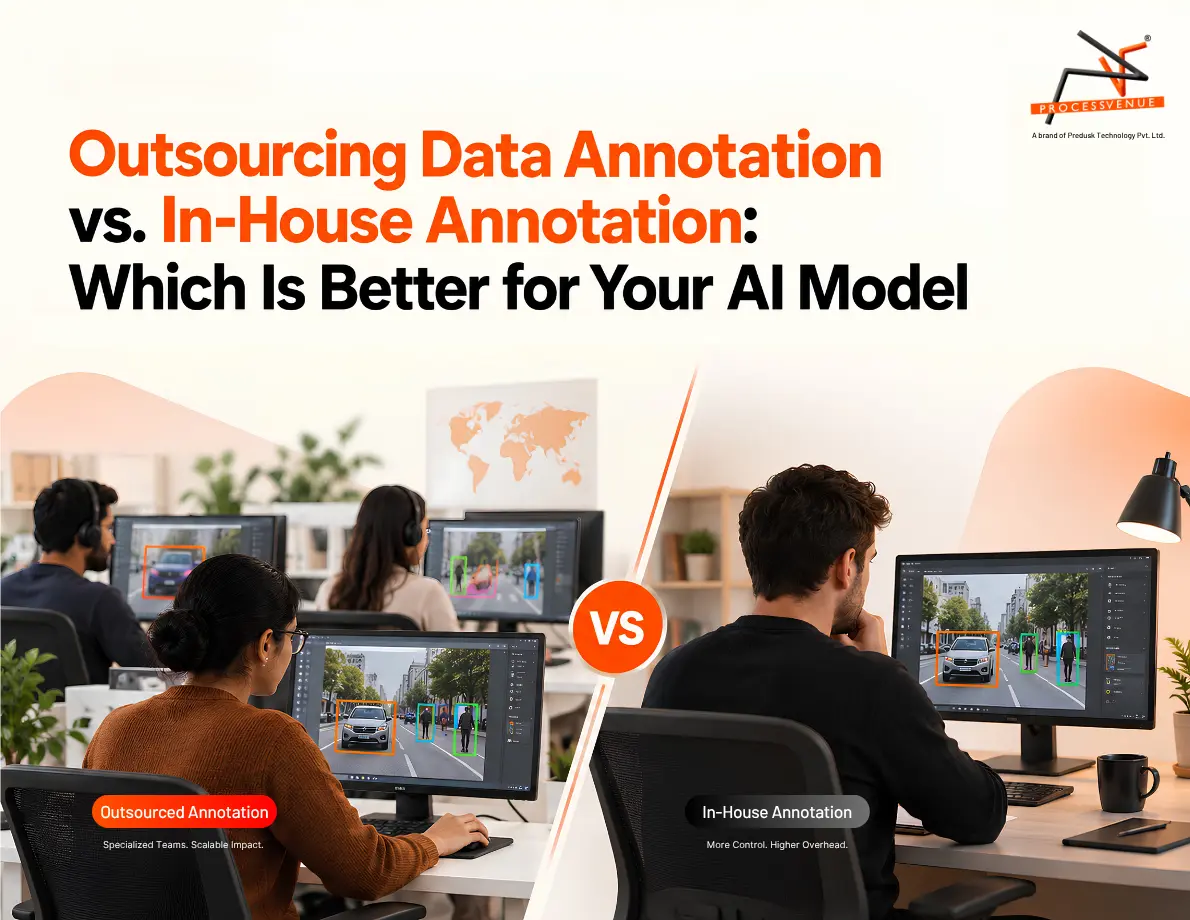
To bridge this gap, enterprises are increasingly investing in AI data annotation. It’s the process of labeling documents so models can learn what information matters and how it appears in different contexts.
The Critical Role of Human-in-the-Loop Annotation
Pure automation works well for predictable scenarios. But documents are rarely predictable. This is where human-in-the-loop annotation (HITL) becomes essential.
In a HITL model, human experts actively guide, validate, and correct AI outputs at key stages of the lifecycle- during initial training, exception handling, and ongoing model improvement.
Humans excel at:
- Resolving ambiguity (e.g., similar-looking fields with different meanings)
- Understanding business context
- Interpreting edge cases and unusual formats
Machines, on the other hand, excel at speed and scale. When combined, they create systems that are both efficient and reliable.
As Andrew Ng famously observed, “AI is the new electricity—but data is the fuel that powers it.” In document processing, HITL annotation is what refines that fuel.
Hybrid Data Annotation: The Operating Model That Scales
Leading enterprises are moving away from fully manual or fully automated approaches toward hybrid data annotation models, often described as human + AI annotation.
In this setup:
- AI performs first-pass extraction across large document volumes
- Humans validate outputs, correct errors, and annotate edge cases
- Corrections feed back into the model, improving future accuracy
According to Deloitte, organizations using hybrid human-AI workflows report significantly faster model improvement cycles and more stable accuracy over time compared to automation-only systems.
This approach ensures:
- Higher confidence in extracted data
- Reduced error propagation across systems
- Continuous learning without constant retraining from scratch
Why Enterprises Are Outsourcing Document Processing
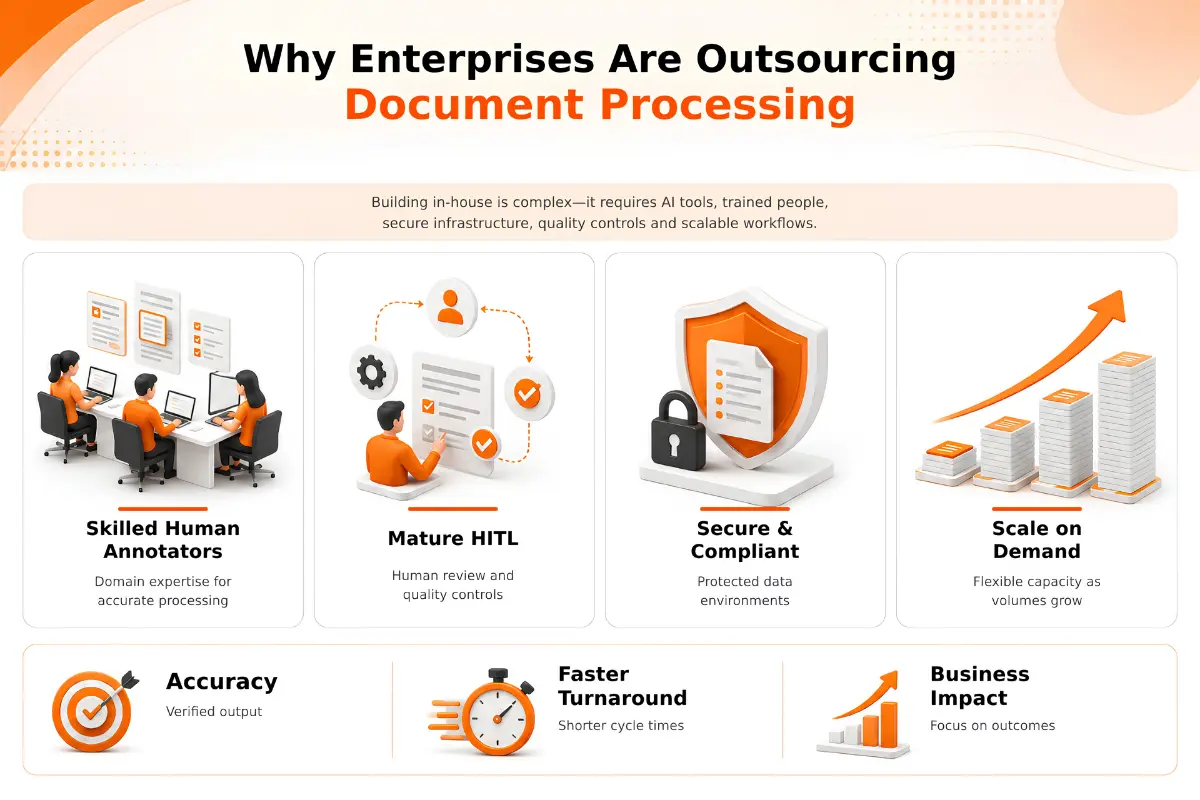
Building and maintaining this level of capability in-house is complex. It requires not just AI tools, but trained annotators, secure infrastructure, quality controls, and scalable workflows.
As a result, many organizations are turning to document processing outsourcing partners who specialize in operationalizing AI responsibly. This shift is not driven by cost arbitrage alone. It reflects a need for:
- Access to skilled human annotators
- Mature HITL processes
- Secure, compliant data environments
- The ability to scale annotation volumes on demand
Outsourcing allows enterprises to focus on outcomes like accuracy, turnaround time, and business impact, while relying on partners to manage execution complexity.
What Leaders Should Ask Before Outsourcing Document Processing
Before choosing a partner, enterprise leaders should consider:
- How is training data created, reviewed, and improved over time?
- Where exactly are humans involved in the AI lifecycle?
- How are exceptions and errors handled?
- How does the system learn from corrections?
- What data security and compliance measures are in place?
The answers to these questions often determine whether AI delivers lasting value or creates hidden risks.
ProcessVenue’s Point of View: Annotation as a Workflow Discipline
From ProcessVenue’ s perspective, document processing is not a standalone AI project, it’s an ongoing operational workflow. Rather than treating annotation as a one-time task, ProcessVenue embeds HITL data annotation into live document pipelines. AI models handle volume, while trained human teams ensure precision, governance, and learning continuity.
This hybrid data annotation approach is designed to support enterprise use cases across finance, operations, analytics, and customer-facing processes where errors carry real business consequences.
The focus remains on outcomes:
- Improved AI model accuracy
- Faster document turnaround
- Reliable data for downstream automation and analytics
By combining execution discipline with AI readiness, Processvenue positions document processing as a strategic capability rather than a back-office function.
From Extraction to Intelligence
AI has transformed document processing. However, simply having better intelligence does not ensure better business outcomes. It emerges when human judgment and machine learning work together continuously refining accuracy, context, and trust.
For enterprises looking to scale AI responsibly, document processing outsourcing that’s grounded in human-in-the-loop annotation and hybrid data annotation is becoming a cornerstone of smart data extraction.