
 sahil wadhwa
 November 25, 2026

Content of blog
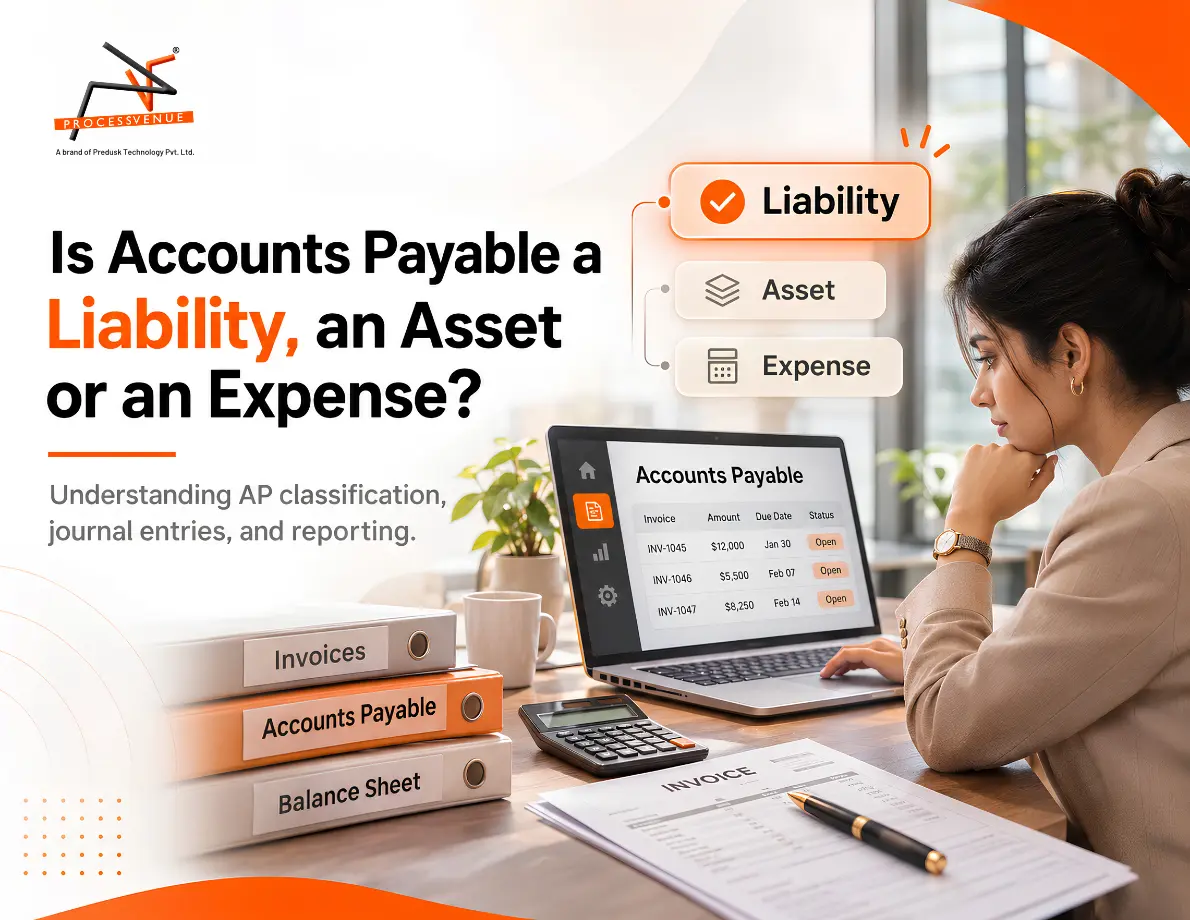
Is accounts payable a liability? Yes. It’s a current liability (the money that a business owes its suppliers for goods and services it has already received but not yet paid for, normally due in 30 to 90 days). It’s not an expense (the expense is recorded at the point of incurrence) and it’s not an asset. Accounts receivable is the asset on the other side of that same invoice.
If you’re looking to improve your AP process without the need to outsource then regular invoice reviews, setting up reminders for due dates and looking at automating invoice capture and coding are all worth a go. That will go some way to preventing missed payments, minimizing the amount of manual work and ensuring your records are current. If your team are spending more time chasing invoices than actually looking at the invoices then have a look at how ProcessVenue’s accounts payable outsourcing deals with it.
Is account payable a current liability? Why the answer is yes
So is accounts payable a liability for every business? Under accounting yes it is. A business records what it owes the moment it receives the goods or services on credit rather than when the cash leaves the bank and that is a liability on the balance sheet.
The balance sheet also categorizes liabilities by when they are due. Anything due within 12 months, or within one operating cycle, is a current liability. Standard supplier terms such as net 30 or net 60 would obviously fall within that 12 month window so accounts payable is almost invariably a current liability and appears alongside accrued expenses and short term debt.
The label is important as AP feeds into working capital and DPO. If you understate payables then both AP and DPO will look better than they are.
One exception to that is businesses that keep their books on a cash basis who will not record any accounts payable at all. The expense only appears when the bill is actually paid.
Is accounts payable an expense? No, and here is why
The expense and the payable both arise from the same invoice, but they are in different places on the statements and they mean different things. The expense is the cost of what you’ve used and appears on the income statement in the period you used it. The payable is the obligation you still have to pay and will remain on the balance sheet until it’s settled.
Treating AP as an expense means you’re counting the same cost twice (once on the invoice and again on payment). Payment simply clears the liability and reduces cash.
Not every payable is linked to an expense. Inventory purchased on credit gives rise to a payable and an asset. The expense is recognized later as cost of goods sold.
Liability vs expense: how they differ
| What it is | An unpaid obligation to a supplier | The cost of goods or services used |
| Where it appears | Balance sheet, current liabilities | Income statement |
| When it is recorded | When the invoice is received on credit | When the cost is incurred |
Is accounts payable an asset? No, accounts receivable is the mirror
An asset is something that a business owns or controls which is expected to bring a future benefit. Accounts Payable is the opposite: it’s what you owe. So when the question arises as to whether accounts payable an asset or a liability the answer is always the same. It’s a liability.
The asset you’re probably thinking of is accounts receivable (the money your customers owe you). The same invoice is a payable on the buyer’s books and a receivable on the seller’s books. If you sell on credit and you buy on credit you’re managing both sides of the ledger and that’s why so many teams outsource both AP and accounts receivable.
Accounts payable: an asset or a liability?
| Classification | Current liability | Current asset |
| Who owes whom | You owe a supplier | A customer owes you |
| Normal balance | Credit | Debit |
A journal entry example
If your company gets a $5,000 invoice from a freight carrier on the 10th of March (net 30) and pay it on the 9th of April.
| March 10 | Freight expense | $5,000 | |
| March 10 | Accounts payable | $5,000 | |
| April 9 | Accounts payable | $5,000 | |
| April 9 | Cash | $5,000 |
The March entry records the expense and creates liability. April entry eliminates liability and reduces cash. The expense was only recorded once in March, which is precisely why the answer to ‘is accounts payable for a liability’ is yes and the answer to ‘is it an expense’ is no.
What changes in reporting when AP is outsourced
The classification doesn’t change at all. Accounts payable remains a current liability on your books, your team still have the approval authority, and the ledger is still yours. What does change is how complete and how current that liability is at any point during the month.
The most prevalent reporting gap in AP is timing. Invoices that end up in an inbox past month’s end become unrecorded liabilities, and that’s why auditors will invariably run a search for them. An outsourced team that’s capturing the invoices as they come in, matching them to the POS and receipts and flagging the duplicates will close that gap prior to close.
Process Venue runs it as an AI-assisted, human-verified workflow. The AI does the invoice capture, the trained reviewers do the exception checking, and you end up with dashboards on your outstanding liabilities, vendor wise spend and working capital. For a more complete walk-through of the AP process, check out our guide to the AP process.
See how ProcessVenue tracks and reports your AP liabilities.
If the honest answer to “is accounts payable a liability we can report accurately today” is not quite, start with a pilot on one invoice stream. See how ProcessVenue tracks and reports your AP liabilities.