
 sahil wadhwa
 November 17, 2026

Back office outsourcing is often cheaper than an in house team when you consider all the cost of running an in house team (benefits, recruitment, training, attrition, tools and management time etc). You can still have control as long as your contract has SLAs, two pass quality checks and weekly reporting. In house still comes out on top for judgement intensive work and very small volumes. ProcessVenue’s back office outsourcing services start with a 30 day pilot so you can compare on real data.
The standard comparison is one salary against one vendor quote. That completely ignores the cost of the in-house team (in all but the most trivial of cases) and says absolutely nothing about control or risk, which is where most of the outsourcing decisions are actually won or lost. This guide looks at the comparison between back office outsourcing and an in-house team on all three of those factors, using a 10 person back office as the example.
What Back Office Outsourcing Covers
Back office outsourcing is the handover of the repeatable, rules based work that goes behind the scenes in your business to an external team who own the process from intake to delivery. This would normally involve document and data capture, data cleansing and conversion, CRM and catalogue updates, records management and finance support (e.g. invoice processing and reconciliations). The front office (where your people are talking to the customer and making the calls) remains with you.
Modern back office work isn’t manual keying. At ProcessVenue we do data capture via AI assisted extraction, with the human doing the verification and exception handling. The speed is all from the machine. The accuracy is all from the human.
The ideal first candidate is a process that has a stable volume, clear rules and a measurable output. Invoice capture, CRM updates and product catalogue maintenance are all good examples of such a process. If you can write the rules down and you can count the output then the process is ready to go. If the rules are changing every week then it’s not ready yet.
In-house Versus Outsourcing: The Cost You Are Not Counting
Salary is the visible number. Five other costs are underneath it.
- Benefits: according to the US BLS, benefits accounted for 30.0% of private industry employer pay costs in June 2026. For every $70 in wages an employer pays, they’re also paying an additional $30 in benefits.
- Recruitment: According to SHRM’s 2025 benchmarking data the average cost of a non-executive hire is $5,475. Every resignation effectively resets that cost.
- Training and ramp-up: a new joiner takes weeks to get up to speed and an experienced team member will spend time training them.
- Attrition: back office roles are all about attrition. You get a turnover and that creates a vacancy, creates a backlog and then you’ve got another round of recruitment.
- Tools and management time: seats, licenses, hardware and the amount of time a manager spends on scheduling, reviewing and covering absences.
None of them come on a single invoice which is why the in house side of the comparison is so very easy to under estimate.
Control: What Back Office Outsourcers Commit to Versus Line Management
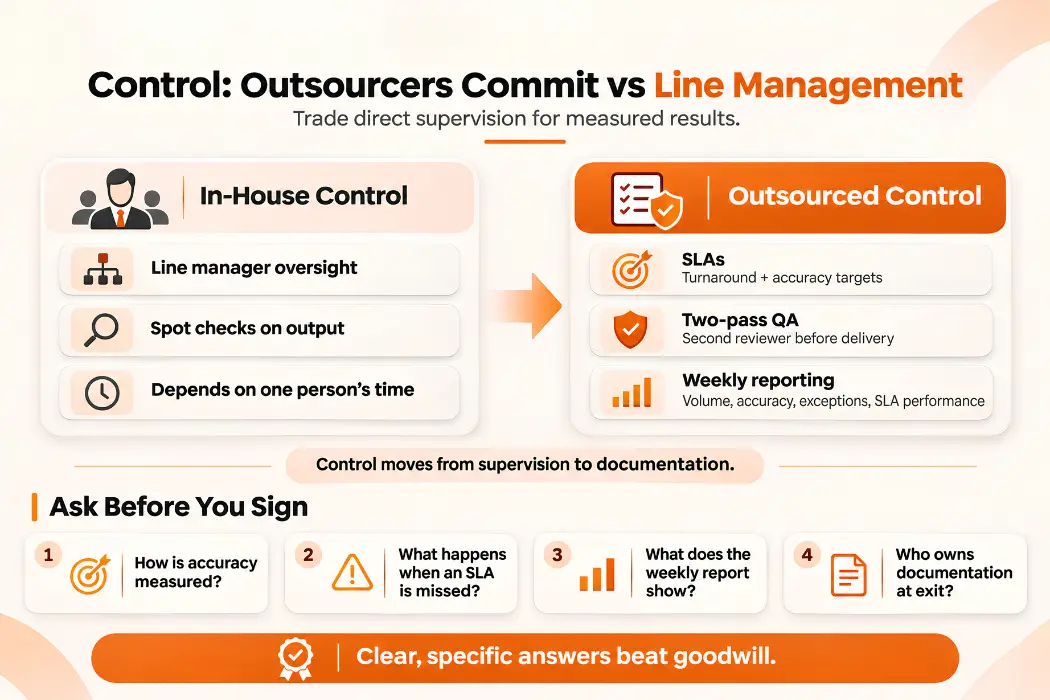
The most frequently raised concern about back office outsourcing is the loss of control. In reality the nature of control changes. With an in house team you have control via line management. Your line manager looks at the work, does spot checks on the output and fixes things as they arise. It works, it just relies on the time and attention of one person.
Good back office outsourcers put control in writing instead. Look for three things in the contract:
- SLAs: turnaround and accuracy targets agreed before go-live
- Two-pass QA: a second reviewer checks work before it reaches you
- Weekly reporting: volume, accuracy, exceptions, and SLA performance in one view
You trade direct supervision for measured results. In a rules based environment that’s often more control than less as the problems manifest themselves in a weekly report rather than a missed month end close.
Before you sign with any vendor, ask four questions:
- How is accuracy measured and who actually reviews the reviewer?
- What actually happens in practice and what is stipulated in the contract when an SLA is missed?
- What does the weekly report actually show, and who on your side reads it?
- Who owns the process of documentation in the event of an engagement ending?
Clear and specific answers are a good thing. The vague ones are the ones where it’s all going to be down to goodwill rather than numbers.
Risk: What Changes When Outsourcing Back Office Work
- Security. Your data is now sitting with a vendor so their controls are as important as yours. Find out what certifications they hold and how access is restricted. ProcessVenue is ISO 27001:2022 certified, SOC2 aligned, HIPAA ready, GDPR compliant and DPDP Act 2023 ready.
- Continuity. A team of ten will have ten people’s sick days, holidays and resignations on their books. A vendor with a bigger trained bench can cover the absences without any work stopping.
- Key person dependency. In a lot of in-house teams you end up with one or two people who hold the process in their heads. When they go the process goes with them. A proper handover forces the process to be documented and thus reduces that risk even if you subsequently bring it back in-house.
The honest counterpoint is that you’re now reliant on a vendor. Mitigate that risk by having your own process documentation, clear exit clauses and a contract that keeps your data entirely yours.
When In-house is The Better Answer
Back-office outsourcing isn’t the right call for every process. Keep the work in-house when:
- it needs deep judgment or context that changes daily, such as negotiating with key suppliers.
- the volume is too small to keep even one dedicated person busy, so onboarding effort outweighs the savings.
- a regulator or client contract requires the work to stay on your premises or with your own employees.
- The process is still being designed; outsource a stable process, not a moving one.
In those cases, tighten the in-house process first and then look at outsourcing again once the work is proven to be repeatable.
A Side-by-Side Table for a 10-Person Back Office
The table compares a 10 person in house back office with the same work done by an outsourced team. It uses the BLS and SHRM figures above and one assumption (that 3 of the 10 people leave during the year).
Back Office Outsourcing Cost and Control for a 10-Person Team
| Factor | In-house team of 10 | Outsourced team |
| Wages and benefits | Wages plus benefits, which run about 30% of total compensation (BLS) | One agreed monthly fee for the team |
| Recruiting | About $16,425 a year for three replacement hires at $5,475 each (SHRM) | Vendor recruits and replaces staff |
| Training and ramp-up | Your experienced staff train each new hire | Vendor trains people before they touch your work |
| Tools and seats | Licenses, hardware, and space for 10 people | Included or quoted separately, so ask |
| Management time | A supervisor manages people, schedules, and quality | Your manager reviews a weekly report |
| Absence cover | Work slows when people are out | Vendor’s responsibility under the contract |
| Quality control | Spot checks by the supervisor | Measured against agreed SLAs |
| Key-person risk | High if one person holds the process | Process documented during transition |
| Scaling | Weeks to hire up, hard to scale down | Team size adjusted by agreement |
Just plug your own wage and turnover figures into the in house column and the actual gap between the two options becomes apparent very rapidly.